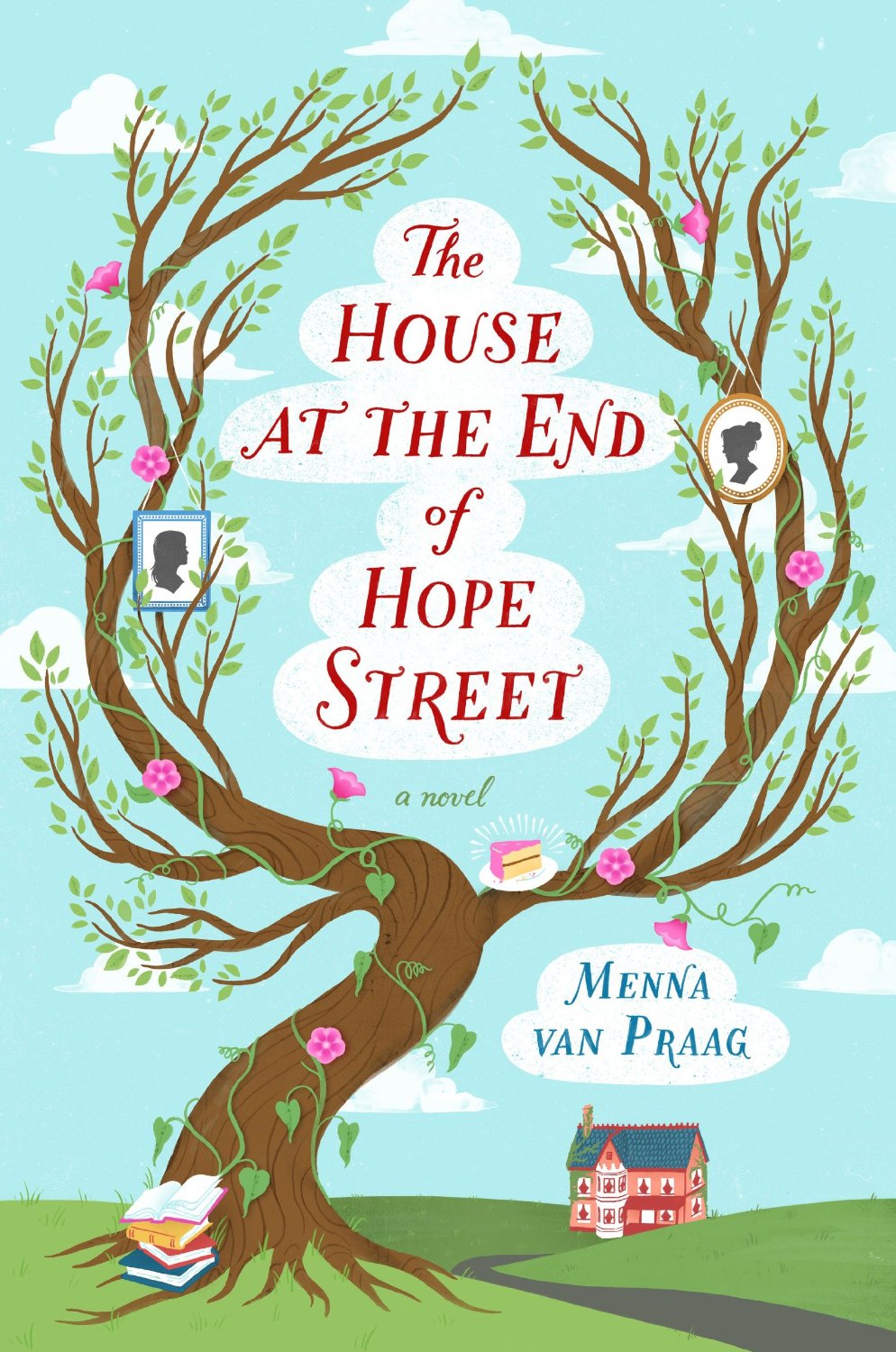
I picked up The House at the End of Hope Street by Menna van Praag because I wanted something light. The book is about a magical house that becomes a haven for women in trouble. The house provided a place of solace for notable people from Sylvia Plath to Virginia Woolf, and their talking portraits now line the hallway (much like the past headmasters of Hogwarts in Dumbledore's office).
This book is definitely light, but it has its moments of sadness. The main protagonist is Alba Ashby, the youngest PhD student at Cambridge University. After her professor steals her ideas for a paper, Alba confronts the advisor and is dropped from her program. She comes from a rich family with a lot of dark history, of affairs and murder accusations. There are other residents at the house--Greer, a down-and-out actor, and Carmen, a singer who is escaping the haunting of an abusive relationship. Peggy is an older woman who is the house's caretaker/landlord with psychic abilities.
I liked the magical elements of this novel and all of the literary references to Plath/Woolf/Dorothy Parker/etc. There are several instances in the novel when characters are brought together by sharing preferences in books, proving that a good novel can unite lovers and estranged family members. This use of books to move along relationships and plot points was lovely.
I was very interested in what was going on in Alba's life, but was less interested in most of the plot lines of the other ladies in the house. Their stories were not as deeply developed as Alba's, and I had a harder time connecting to them. There were also some very one-dimensional characters, like two of Alba's siblings who are so mean and self-centered that they seem like sad cliches of "evil" older siblings (think wicked stepsisters type of thing).
My other complaint was that I found a lot of the lines of prose to be a bit cliched. Point and case: "The twenty-year-old crack in his heart has never really healed" (101). The references the book makes are so focused on the literary that I wish some of the prose/dialogue was stated a bit differently.
I do have to give a thumbs up to van Praag because she portrayed a lesbian relationship in the book in a really natural way, which is something I usually don't find too often in the books I end up picking up by chance (9/10 times the books I grab off the new release section in the library don't give voices to LGBT relationships at all, so this was a nice change).
The book has a nice promising concept, but just needed a little extra uumph--a little more character development, a faster plot in the beginning (I felt like the first bit dragged), and some more aptly-picked prose. I would really only recommend this to those are looking for a light, magical read with some family drama thrown in for good measure.
Monday, May 13, 2013
Sunday, April 28, 2013
I am finally back to writing- A review is coming soon!
Wow, blog, it's good to be back. After working two jobs for months and months, I finally quit one of them and will have more free time on my hands. I got sucked into the abyss of work for longer than I would have liked. The past ten months or so has involved working days, and nights, and weekends, and sometimes 11 or 12 days with no days off and multiple 12-13 hour days in that chunk. This is the life of a graduate in a recession--all of that for a small chunk of money in the grand scheme of things.
But I couldn't do it anymore, so now I am just working the normal Monday thru Friday kind of gig.
And I finally have time to review.
It's starting to become spring where I am, and I want to read something uplifting and spring-like. I picked up this book at the library today, and a review will be coming once I finish it.
I want to thank everyone who has ever looked at this blog, and I feel bad for abandoning it for so long. So here's to more reviews, a less hectic life, and more books.
But I couldn't do it anymore, so now I am just working the normal Monday thru Friday kind of gig.
And I finally have time to review.
It's starting to become spring where I am, and I want to read something uplifting and spring-like. I picked up this book at the library today, and a review will be coming once I finish it.
I want to thank everyone who has ever looked at this blog, and I feel bad for abandoning it for so long. So here's to more reviews, a less hectic life, and more books.
Tuesday, August 14, 2012
The Snow Child
The Snow Child by Eowyn Ivey is
delightful but not without faults. The novel follows the lives of Mabel and
John, two Alaskan homesteaders. Their lives are hard—Alaska is barren, and they
tend rough land and hunt for food. They are also childless, a fact that has
created a great rift between them. Their lives are very desolate at the
beginning of the novel. They have little interaction with each other or anyone
else. As the novel progresses, however, they befriend their neighbors, Esther
and George, and taheir sons.
The crux of the novel, though, is the story of little Faina, a girl who appears one night in their yard after they build a snow child on their lawn in the first flurry of the season. Faina’s story is part harsh reality, part mysticism, and the girl quickly becomes like a child to the old couple. Mabel believes she is a snow child, like that in a story she heard as a child. The girl appears to walk on snow without really sinking in; she cannot stand the heat and disappears every year at the end of winter. Remarkably, she can survive alone in the brutal Alaskan wilderness. To John, Faina appears a feral child. He knows that her father is dead, for the child lead John to her father’s lifeless body one day. As the novel progresses, Mabel and John’s opinion of Faina change and change again. The reader is left wondering: how mystical and magical is the child? And how fallibly real is she?
There are some great things about this novel. The story of John, Mabel, and Faina is mimetic of the tale that Mabel knew as a child—that of an old couple who builds a snow child only to have her come to life but disappear every spring. This feature is interesting, and I enjoyed some of the underlying criticism of fairy tales (they are often very cruel even though they are meant for children). The characters, although a bit stereotypical at times, are enjoyable. The portrait of Alaskan homesteading was particularly fascinating for me, since it is a part of American history I knew nothing about.
I spent a long time trying to figure out what was “wrong” with the novel. As I was reading it, I knew it had shortcomings but couldn’t totally pinpoint them. I think, however, it lies in the fact that at times the dialogue seemed a bit stale or halted. Sometimes I wondered if this was just supposed to be halted because of the time period of the novel and the way people spoke back then, but I am not sure. Ivey did a pretty good job with everything else. Like I said, at times the characters seemed stereotypical, but they rounded themselves out as the novel progressed, although perhaps not as fully as they could have. The final portion of the story seemed a little too rushed, and the first part a little too slow. The pacing simply needed a small shift.
In spite of my criticisms, I did enjoy The Snow Child. If you like fantasy novels that have mere elements of magic and not a completely transformed world, I would recommend this book.
Wednesday, August 8, 2012
The Girls
I have never read a book like Lori
Larsens The Girls. The novel is about a lot of the things that all
novels are about: love, friendship, family, relationships. But The Girls is not any old novel, and the
narrators are not your usual could-be-anybodies. At the time that they are
writing their co-authored autobiography, Ruby and Rose Darlen are almost
thirty, sick, and working in a library (The
Girls is one of those books within a book…a fiction novel that reads like
an autobiography). They are also the world’s oldest surviving craniopagus
twins. That means that they are joined at the head, sharing a major vein. They
can never be separated, and because of the way they are connected, they have
never seen the other’s face except for in mirrors or photographs.
Rose is the academic, and the main
writer of the autobiography. She is sporty and bookish at the same time, with a
verbose yet poignant way of looking at the world. She weaves in her own story
with that of her sister’s, her Aunt Lovey and Uncle Stash—her adoptive
parents.
Ruby is interested in history, and
a fan of TV. Although Rose often says that Ruby is the weaker of the two, Ruby
comes across strong in the chapters that she writes. Although she is clearly
not as “writerly” as her sister, her chapters add simplicity to the complex
narrative that Rose writes, breaking the novel up in a pleasant way.
There are stories of lost children,
pregnancies, crushes and loves, death. There are tales of magic and witches, of
superstition and fact. Of crows and family. Of growing up and being a child and
being different during all of that.
It took me a while to read The Girls. Rose’s chapters are very
thick feeling and take some time to get through, but I think the main reason
that I was so slow to finish the book was that I didn’t want it to end. This
book…I will never forget this book. It is everything I love about a novel—great
characters, good plotlines, fantastic language—with the added punch of being
about a topic like growing up as a conjoined twin. It is unique, without feeling gimicky. If the book was just about two sisters not joined at the head, it would be still stand up as a great novel.
I give author Lori Lansens major
credit for being able to write about being a craniopagus twin, when she
obviously isn’t, with such clarity. She doesn’t leave out details—questions
about love-relationships and being a conjoined twin were in my mind when I
started reading this novel, and they get addressed because one of the twins
conceives at one point in the story. She also doesn’t make the whole novel
about the twins. Aunt Lovey and Uncle Stash’s relationship are woven
beautifully into the tale, and they become fascinating with all of their flaws
and perfections.
I can’t even express how much I
recommend this book—if you want to read a good, different, and beautifully
written novel, pick up The Girls.
Labels:
Death,
Family,
Fiction,
Lori Larsens,
Love,
Relationships
Wednesday, July 11, 2012
Friends Like Us
Okay, so I picked Lauren Fox’s Friends Like Us thinking it would be like watching a rom com
(romantic comedy) at the movie theater but that I would get to read it. I think
anyone who majored in English or creative writing sometimes feels like you
shouldn’t read books that are rom coms or “lesser” fiction…like we’re supposed
to sit around and read Moby Dick and A Tale of Two Cities all day. But
sometimes, I just want a break. Friends
Like Us was my break (not like I actually sit around and read Moby or A Tale…I haven’t picked those up since high school. I was just
making a point, I guess).
Friends Like Us has
a 3-star rating right now on Goodreads, and up until I got to the end of the
novel, I agreed. But I think the end pushes it up to a 3.5 or 4-star rating.
The premise of the story is this: Willa and Jane live together, and are the
best of friends. They went to college together and are now in their
mid-twenties. They work shitty jobs. They are in the transition phase, just like
the rest of us post-grads. At a high school reunion, Willa reunites with her
best friend from high school, Ben. He confesses to her that he had a huge crush
on her in high school. They make out, but then decide that it all feels weird.
They agree to go back to being friends.
Ben starts hanging around a lot at Jane and Willa’s
apartment, and Willa sets them up. The plot is predictable for the most part.
Willa dates a guy who is kind of a jerk, and they break up. Jane and Ben get
engaged. I don’t want to spoil the ending, but in the prologue of the book you
know that Jane and Willa are no longer friends. And as the end of the book
nears, I knew there were a few turns the book could take. Sure enough, it took
one of those. But the ending was surprisingly realistic—I thought Fox was going
to wuss out and sugar-coat it. She doesn’t thought, and the characters all kind
of end up where they need to be, even though it might not be as glossy of an
ending as a rom com at the movie theater. For sparing us from another unrealistic
end to a romance book, I commend Fox. It’s not a life changing novel, but it is
good for chick lit.
There are a few problems with it. Mainly, the characters
motivations need to be fleshed out a bit more. Sometimes I found myself
wondering why: Why is Willa self-sabotaging? Is Ben only with Jane because she
is so similar to Willa?
My favorite part of the novel was not necessarily the plot,
but the dialogue. I have not read such true-to-life dialogue in a long time.
Ben, Willa, and Jane talk like me, like people I know. I dog-eared page 141
where Fox writes the following passage:
“A few weeks ago, Jane sent me an e-mail (she was in her
bedroom and I was in mine). Can you teach
me how to talk dirty? She wrote.
Mud! I wrote back. Motor oil!
Seriously.
Why do you think I know? I typed
back.
You have more experience than I do. You’re
more slutty.
Let’s roll around in a pile of
sewage, baby.
Seriously, she wrote again. I would like to know what it entails.
Entrails!
Julian said you’re supposed to,
like, describe what you want. Jillian was a girl we knew in college who
worked part-time at Hooters. She had a worldly quality about her. Like, ‘Take me from behind,’ or whatever.”
The dialogue is very natural, but also has the over-use of
puns, much like an episode of the Gilmore
Girls. I have to say, because of her use of funny and witty dialogue, I am
probably going to read Fox’s first novel Still
Life with Husband. I recommend Friends
Like Us, but probably for those looking for a lighter read with some funny
dialogue and not quite as glossy of a finish as When Harry Met Sally.
Sunday, June 17, 2012
Growing Up Amish
This book popped up on my Goodreads account a few weeks ago, and I decided I would check it out. I was always interested in the idea of Rumspringa--the time in Amish life where the youth run wild before joining the church as adults. Sometimes this means leaving their communities, sometimes it just means sneaking around and experiencing the outside world on the sly. The Amish believe that only adults can fully accept Christ, so people are baptized around the age of 18, give or take a few years.
Ira Wagler in Growing Up Amish runs wild for a period of several years. When he is 16, he runs away in the middle of the night from his community in Bloomfield, Iowa with his friends. They live like cowboys, working on a farm. They drink. They smoke. They meet girls. This would be the first of Ira's five trips out of the Amish community and into the world.
For the next ten years of his life, he lives in a constant state of longing. If he is in the Amish community, he longs for the outside world. For cars. For booze. For freedom. When he is in the outside world, he longs for his family and the stability that comes with the Amish lifestyle. Not even a total believer in God or the church's message, and guilt-ridden because of his many sins, Wagler also worries that he will die on the road and go straight to hell. Eternal damnation is a lot of pressure, and one of the other reasons he returns home so many times.
After returning from his third trip into the outside world, Wagler comes home and joins the church. When he is baptized he feels nothing. But he tries desperately to settle into Amish life and have what his parents have. He begins courting a girl named Sarah, and the two even get engaged. However, as life moves along, Wagler becomes increasingly aware that he cannot stay. He misses the outside world. He knows he will not be happy. So he leaves. Again. And is excommunicated
But after being out in the world, he once more wishes to return to the Amish way of life. He is also concerned with his soul. He writes, "The Amish have always taught, always preached, that once the desire to return leaves, that's when you are truly lost." Afraid of being truly lost, Wagler grasps onto his feelings of sorrow over abandoning the Amish. He attempts to return to the church. The Amish church in Bloomfield accepts him back, but he leaves Bloomfield for a different settlement, trying to create a different but still Amish life for himself.
It is on his fifth return to the Amish church he has a spiritual awakening and begins to believe in God. He also believes that God forgives him for his sins. Less concerned for his soul and the threat of eternal damnation, he starts to realize that maybe he can leave the church and not be damned forever. He decides to do this, and makes his final, permanent exit from the Amish church. He moves to Pennsylvania and joins a Mennonite church.
Growing Up Amish is moderately well-written. In writing classes you always hear, "Show, don't tell." As in, paint a picture for your reader, don't just tell them what events happened. Wagler does a good amount of showing, but sometimes he simply tells and can get a bit repetitive. These problems happened most clearly towards the end, where the book begins to get a little bit rushed. However, some of his sentences are beautiful and he turns a nice metaphor every now and then.
This book may not be highly literary, but it is highly informative and sometimes, surprisingly, relatable for those of us in the outside world. There is one scene where he discusses a boy in his school who was brutally bullied by the other children. One wouldn't imagine such holy societies to have such horrifying bullying problems (the child is beat up on a daily basis, mocked, etc.), but in that sense their schools are just like ones in the outside world. Wagler also explains all of the ins and outs of Amish life, which I appreciated. I learned a lot about a culture I didn't know much about.
I also could relate to Wagler's pull between one world and another, to a small degree at least. I often felt that way about college. When I was away at school, I missed home. Then I would go home and miss school. I know there are other boomerang generation-ers out there who know what I'm talking about. Obviously there was a lot less riding on these torn emotions. Being conflicted between home and college is much different than an Amish person being torn between their community and the outside world. When I was at school, I wasn't concerned about the fate of my soul or forever being exiled from my parents. One of the successes of this book is the fact that Wagler did a great job at making a very unique experience seem somewhat relatable.
For memoir readers out there, I definitely recommend this one.
Ira Wagler in Growing Up Amish runs wild for a period of several years. When he is 16, he runs away in the middle of the night from his community in Bloomfield, Iowa with his friends. They live like cowboys, working on a farm. They drink. They smoke. They meet girls. This would be the first of Ira's five trips out of the Amish community and into the world.
For the next ten years of his life, he lives in a constant state of longing. If he is in the Amish community, he longs for the outside world. For cars. For booze. For freedom. When he is in the outside world, he longs for his family and the stability that comes with the Amish lifestyle. Not even a total believer in God or the church's message, and guilt-ridden because of his many sins, Wagler also worries that he will die on the road and go straight to hell. Eternal damnation is a lot of pressure, and one of the other reasons he returns home so many times.
After returning from his third trip into the outside world, Wagler comes home and joins the church. When he is baptized he feels nothing. But he tries desperately to settle into Amish life and have what his parents have. He begins courting a girl named Sarah, and the two even get engaged. However, as life moves along, Wagler becomes increasingly aware that he cannot stay. He misses the outside world. He knows he will not be happy. So he leaves. Again. And is excommunicated
But after being out in the world, he once more wishes to return to the Amish way of life. He is also concerned with his soul. He writes, "The Amish have always taught, always preached, that once the desire to return leaves, that's when you are truly lost." Afraid of being truly lost, Wagler grasps onto his feelings of sorrow over abandoning the Amish. He attempts to return to the church. The Amish church in Bloomfield accepts him back, but he leaves Bloomfield for a different settlement, trying to create a different but still Amish life for himself.
It is on his fifth return to the Amish church he has a spiritual awakening and begins to believe in God. He also believes that God forgives him for his sins. Less concerned for his soul and the threat of eternal damnation, he starts to realize that maybe he can leave the church and not be damned forever. He decides to do this, and makes his final, permanent exit from the Amish church. He moves to Pennsylvania and joins a Mennonite church.
Growing Up Amish is moderately well-written. In writing classes you always hear, "Show, don't tell." As in, paint a picture for your reader, don't just tell them what events happened. Wagler does a good amount of showing, but sometimes he simply tells and can get a bit repetitive. These problems happened most clearly towards the end, where the book begins to get a little bit rushed. However, some of his sentences are beautiful and he turns a nice metaphor every now and then.
This book may not be highly literary, but it is highly informative and sometimes, surprisingly, relatable for those of us in the outside world. There is one scene where he discusses a boy in his school who was brutally bullied by the other children. One wouldn't imagine such holy societies to have such horrifying bullying problems (the child is beat up on a daily basis, mocked, etc.), but in that sense their schools are just like ones in the outside world. Wagler also explains all of the ins and outs of Amish life, which I appreciated. I learned a lot about a culture I didn't know much about.
I also could relate to Wagler's pull between one world and another, to a small degree at least. I often felt that way about college. When I was away at school, I missed home. Then I would go home and miss school. I know there are other boomerang generation-ers out there who know what I'm talking about. Obviously there was a lot less riding on these torn emotions. Being conflicted between home and college is much different than an Amish person being torn between their community and the outside world. When I was at school, I wasn't concerned about the fate of my soul or forever being exiled from my parents. One of the successes of this book is the fact that Wagler did a great job at making a very unique experience seem somewhat relatable.
For memoir readers out there, I definitely recommend this one.
Labels:
Culture,
Family,
Ira Wagler,
Memoir,
Non-Fiction,
Relationships
Thursday, June 14, 2012
Night Flying
Night Flying by
Rita Murphy is a tiny little book, clocking in at just over 120 pages. It’s a
nice book to read when you need some fast yet fulfilling fiction. I read this
one a few years ago, and re-read it this week while I was waiting for a book in
come in at the library. The premise is about, well, night flying.
Narrator Georgia Louisa Hansen is from a family of female
fliers. Her Great-Great-Great Grandmother Louisa Hansen lost her husband and
baby boy in a boating accident in the 1800s. She used to fly out across the
water at night in her sleep looking for her loved ones. Thus, the flying gene
was passed down but only to the Hansen women.
The Hansen women are one for rules. Only fly at night. Only
eat meat. No men allowed. Do not fly alone until you are 16. No pets allowed.
Fifteen-year old Georgia’s life is regimented by these rules, which are
enforced by her grandmother. Her mother, Maeve, a frail woman, is not allowed
to fly. Georgia learns the way of the skies through her aunts Suki and Eva. The
three sisters, Grandmother, and George make up the Hansen household. George has
never met her father.
The women never have to worry about money. Georgia’s
great-grandfather created a special part that makes flushing a toilet easier,
and the women live off of the inheritance, or as they call it the “toilet
money.” Georgia’s grandmother threatens banishment from their estate and the
seizing of their “toilet money” if the sisters or Georgia break any rules. Georgia’s
Aunt Carmen was banished from the family after she broke the rule—Georgia has
never been clear on the details.
But when the week of Georgia’s sixteenth birthday rolls
around, Carmen flies into town (literally), and family secrets begin to creep
out of the Hansen sisters. And a rebellion against Grandmother’s rules slowly
starts.
There are a few gaps—for example, I would have liked to
understand the grandmother’s relationship with her husband. What happened in
their marriage? Was he banned from the premises? The grandmother refused to let
any of her children have a man around—for fear they will challenge her
authority—but how did she have four kids with the same man? He must have been
around for at least a few years.
Night Flying is a
wonderful little piece of young adult fantasy, and a great piece for the young
feminist reader. It’s about strong women, making their own rules, and fighting
oppression (in the form of the grandmother character). In some ways, it appears
very radical—with the “no men allowed” rules and all. However, as the book goes
on, those old rules begin to dissolve and the reader is left with strong women
who are not anti-man, but anti-authoritarian. A quick google search finds Night Flying on many lists of young
adult feminist books, like this one. I definitely recommend this one for a
quick, thoughtful, feminist read.
Monday, June 11, 2012
Wayward Saints
Wayward Saints by Suzzy Roche (of the folk band the Roches) follows the lives of Mary
Saint, lead singer of the once indie-famous band Sliced Ham, and her friends
and family. Mary left her home of Swallow, New York as a teenager, leaving
behind her mother, Jean, and abusive father, Bub. She travels the world with
Sliced Ham. The band starts to grow in popularity, but they become weighted
down by drugs and liquor. Her lover and fellow band mate, nicknamed Garbagio,
falls intoxicated from a balcony and dies one night. Sliced Ham peeters out
from there, and Mary slips into depression and alcoholism. She recovers, eventually,
and moves to San Fran. There, she meets a tranny named Thaddeus at a homeless
shelter, and the two move in together. It is then that she gets the call from
her mother, asking her to return to Swallow to play a show at the town’s high
school.
Jean has been living on her
own since she checked Bub into a nursing home after he suffered a stroke. When
the English teacher at the high school approached her about contacting Mary to
do a show, Jean was hesitant but complaint. Throughout most of the book she
anxiously awaits her daughter’s return, trying to understand her abusive
relationship with her husband and distant relationship with Mary. She
coincidentally meets Garbagio’s father—his wife is in the same nursing home as
Bub—and the two strike up a friendship. Jean is also incredibly devout, and
much of the book focuses on how she grounds herself with her faith.
There is a cast of secondary
characters that float in and out of the book, but Mary and Jean are the staples
that keep the novel propelling forward. Although the book is told in the
third-person omniscient, I found most of the closer looks at secondary
characters to be a bit unnecessary. I was always most interested in Mary and
Jean.
Wayward Saints is Roche’s debut novel, and it is somewhat uneven because of that. For
example, Mary seems very authentic and her character is fully conveyed to the
audience. Somehow, she doesn’t fall into the stereotypes of “alternative rocker
chick” and manages to seem fresh and interesting. However, there are other
parts of the book that are less realistic or fleshed out. The conversations
between Jean and Garbagio’s father are ones I know are supposed to be
meaningful but felt a little trite to me. Whenever I was reading the dialogue,
I kept thinking that their conversations needed to go a little deeper, and the
word choice needed to be a little more original. The dialogue itself felt flat,
even though I cared about both of the characters and their relationship. “This
is exactly how I would expect older people to interact with each other,” I
found myself thinking.
Another place of unevenness
was the theme of religion and faith. The references to religion and the
characters’ attachment (or discord) from God are constantly present throughout
the novel. However, Roche needed to expand the theme a little more. When Mary
was a child, she thought she was visited—and fondled—by the Virgin Mary. Mary finds this memory to be somewhat of a
comfort, and states the Virgin gave her the strength to sing. Her devout mother
finds this vision appalling. By the end of the novel, I couldn’t quite
understand what we were supposed to
feel about religion. Is it a support system? A fantasy? A crux? All of these
things?
I did appreciate the way the
book looks at the music industry. It is critical of it (for its drugs, money,
alcohol) but also encapsulates the magic of a good live show, which can be a
quasi-religious experience in itself. I think in the future Roche will be able
to flesh out her novels a bit better. I was reminded of when I reviewed High Fidelity. One of the things I loved
about that book was that it was equal parts a wonderful book about music and a
wonderful book about relationships. Wayward
Saints is a wonderful book about music and an ok book about relationships. More than anything, the book just had the feeling of being published a draft too soon. But
the prose is beautiful, clean, and descriptive. And I have faith that Roche’s
second novel will be even and masterful.
Friday, June 8, 2012
The Year of Magical Thinking
I am not sure what I can say
about Joan Didion’s non-fiction book The
Year of Magical Thinking that hasn’t been said before in a review. The book
is famous, a masterpiece even, for a reason—it is complex, masterful,
reflective, and beautifully sad. Instead, I wish to offer more of a reading guide to the piece.
If you haven’t read the
book, here’s what it’s about: Writers and couple John Dunne and Joan Didion watch
their only child, Quintana, develop pneumonia and septic shock several days
before Christmas in 2003. She is admitted to the hospital in critical condition
and falls unconscious. A few days later on December 30, 2003, while Quintana is
still comatose, John is struck at the dinner table by a massive coronary. He
dies instantly. After several weeks, Quintana regains her health. She travels
to California with her husband Gerry where she collapses in LAX. She is rushed
to the hospital where she is diagnosed with a massive hematoma. Quintana, once
again, falls unconscious and gravely ill but later recovers.
Didion attempts to make
sense of these events, and attempts to understand death. She researches death
and the medical problems her loved ones suffer. She turns to the literature.
She is a smart, grounded woman, but a part of her still expects John to come
back. It is this expectation of his return that she refers to as her “magical
thinking.”
Clearly, this book is a
rough book to read. It has been on my list for about two years now, as I am
quite a fan of Didion. The Year of
Magical Thinking is a book that people always talked about in my writing
classes in college. It’s an important book in terms of style—Didion never falls
into being overly sappy or sentimental, which is a challenged giving the
subject matter. (Who could blame her if she did get sentimental or sappy?) If
you are going to write a book about death, this is a model of how to do it
effectively.
But, like I said, all of
this has been said before about The Year
of Magical Thinking, so I am going to give two pieces of advice to the
reader of this book, based on my own experience. First of all, read it when you
must, when it fits for your life. There were other times in my life when The Year of Magical Thinking could have
been of use to me, but I decided to pick it up now. The book made me scared of all
of the terrible things that can possibly happen.
I think if I had been reading this at a rougher period in my life, I could have
related to the book more. But instead it just made me nervous. I read the book
quickly, trying to get through it so that I could escape the parts of it that
made me uncomfortable.
Which brings me to my second
piece of advice: Read this one slowly. Read it carefully; absorb it; pay
attention to how Didion copes through language. I remember in “The White Album”
she writes, “We tell ourselves stories in order to live.” This is what Didion
is doing in The Year of Magical Thinking.
She constantly puts the events of John’s death and Quintana’s illnesses
into a story, into a timeline. She slows down. She takes the time she needs to
make sense of the events in her life. So when you read it, don’t power through
it. Take it nice and slow.
In summation, read The Year of Magical Thinking when it is
necessary to your own understanding of your own circumstances, and read it
slowly. Do not read it like I read it—fast, wanting to know what happens next
but also trying to escape the difficult subject matter of death that Didion
forces her reader to confront.
Labels:
Death,
Family,
Joan Didion,
Memoir,
Non-Fiction,
Relationships
Thursday, June 7, 2012
The Weird Sisters
The Weird Sisters is one of those novels that you think about a lot while you read it. The
premise involves three sisters—Rose (Rosalinda), Bean (Bianca), and Cordy
(Cordelia)—who move in with their parents because of their own various failures
and problems. However, they all make the transition back to the nest under the
guise of helping their mother who has just been diagnosed with breast cancer.
The book doesn’t leave you in the time between when you are reading and when
you are not. I found myself thinking about the novel throughout the day: Which
sister was I the most like? Responsible, homebody Rose? Sneaky, party-girl
Bean? Free, gypsy-esq Cordy?
All of the girls move home
with secrets—Rose is too afraid to leave her hometown and move to England with
her fiancé, Johnathan. She uses the excuse of her mother’s cancer as a reason
to move back in with her parents and avoid following Johnathan to his new,
one-year job in London. Cordy is pregnant and returns to her parents’ house
where she tries to keep her situation hidden. Bean has just been caught
stealing from her job in New York. Penniless and indebted to her former
employer, she trots back to Ohio.
This book isn’t heavily plot driven—most of the plot points are a bit predictable. However, the interesting part of the novel is watching how the three sisters grow as individuals and as a family. The nature of the novel constantly comes back to questions of identity: Is it possible to define yourself and your personality in a vacuum? Does your role in your family play a part in your self-definition? For example, Bean is often left feeling self-conscious because she is neither the responsible Rose nor the loveable Cordy. Similarly, Cordy has always been the baby of the family and has a hard time seeing herself as an adult who is about to have her own child. The girls come to realize that they can be defined separately from their family while still having a connection to their roots.
Brown also discusses the nature of hometowns—how they can be hard to leave and hard to come back to. The duality of hometowns is something that has always been a favorite topic of mine in my own writing, and I really admired Brown’s discussion of the subject. Each sister represents a stance on their hometown of Barney: Rose never wanted to leave. Bean moved somewhere else and made that her home. Cordy never wanted to have a home at all and lived a wanderer’s life. However, by the end of the book, the sisters’ views on hometowns/homes shift. At one point Cordy says, "We all want to become something better than Barney, but we won't" (313).
The together/separateness of the characters in the novel is mirrored by the point of view in which Brown writes. I have never read a book with this exact style. It is told in the first-person plural (think The Virgin Suicides), with the sentences focused around the sisters as the collective “we.” However, much of the book breaks away from the collective mentality and focuses on a specific sister with the third-person voice. The book will discuss just what Cordy is doing at the moment, for instance.
The book is aware of its own literary prowess. The characters often talk in lines of Shakespeare, because of the sisters’ father being a scholar on good ole Bill’s work. The Weird Sisters are a reference to Shakespeare’s witches in Macbeth and the girls are individually named after characters in various plays.
The Weird Sisters is great for two kinds of readers: those who enjoy a unique point-of view narration and literary allusions, and those who like stories about people going through changes and transitions. It’s a great read, and I highly recommend it.
Wednesday, June 6, 2012
The Cabinet of Earths
So I've been writing for Yahoo! Contributor Network, and I reviewed this children's book for their site. Not what I usually review, but check it out anyway! It was a cute book. Also, I will be writing a review of Eleanor Brown's The Weird Sisters within the next day or two, so check back!
Thursday, May 31, 2012
The Sex-Lives of Cannibals: Adrift in the Equatorial Pacific
Anyone who knows me knows I’m not really an adventurous
person. I’ve lived a pretty typical American life, and I’ve never been out of
the country. Reading The Sex Lives of
Cannibals: Adrift In the Equatorial Pacific by J. Maarten Troost is almost
like reading a fantasy novel of another realm. Whereas I’ve never even seen the
countries that border the US, author Maarten and his wife Sylvia travel to the
Kiribati, a country consisting of a series of atolls spread throughout the
Equatorial Pacific.
After finishing grad school and flitting around through random temp jobs, Maarten doesn’t really know what to do with his life. Sylvia is in a similar boat, and the two of them begin searching for jobs in remote parts of the world. As someone who is in a similar stage of confusing unemployment, I can't help but admire Sylvia and Maarten for being so brave. I won't even contemplate moving out of my state, and these two apply to move halfway across the globe. Eventually, Sylvia gets an offer to join a development team on Kiribati’s capital atoll Tarawa, and when the two arrive Maarten assumes the role of homemaker on an island known for its subsistence living. Sylvia’s predecessor told them that the island was hell, and Maarten and Sylvia begin the adjustment process.
This is what Tarawa is like: It is hot. So hot. So hot that when one I-Kiribati (the name for people native to the island) went to Hawaii, he returned complaining how bitterly cold the trip was. Water is hard to come by on the atoll, and the only real type of vegetation is coconut trees. Fish are the main staple of the Kiribati diet. The average I-Kiribati consumes over 400 pounds of fish per year. There are no seasonings to put on the fish, and many of the types of fish that surround the atoll are toxic. Disease is common on Tarawa. Maarten and his wife suffer from all kinds of illnesses during their stay. But somehow, the island becomes their home, and they are more than a little bit shell-shocked when they return to America two years later.
The book is full of funny and terrifying anecdotes. For example, at one point, Maarten attempts to create a garden. He builds a fence for it, only to discover that the piece of plastic he plucked out of the reef to use as a latch is actually a hospital IV full of blood.
The Sex Lives of Cannibals is a really fantastic travel book, but also one that is great for the reader interested in international development. Maarten takes ample time in the book to discuss the pitfalls of the international aid industry and developmental politics. He goes into the complex history of Tarawa and Kiribati while also describing the internal politics of the country.
As someone who studied politics in college and has read many books and articles on the international aid industry, The Sex Lies of Cannibals stands out as a more relatable exploration of the issues that plague the developing world and the aid industry. The book is a personal look, written by someone who has seen the aid industry at all angles.
After returning from Kiribati, the Troosts are strapped with debt. Maarten says to Sylvai at one point in the book after they return from Tarawa, "Remember that meal we had in Annapolis three years ago? Well, after three years of interest and late fees and finance charges, that meal is going to cost me $1,500" (266).
Their unfortunate financial situation pushes Maarten into accepting a job with the World Bank, where he receives a large pay check but eventually becomes the kind of person he used to hate. Maarten's experience with grassroots development projects like the ones Sylvia started on Tarawa, and his knowledge of the projects the World Bank starts makes him a reliable source. He has seen both, and knows that the large-scale ones created by international institutions are out of touch with the reality of the places they claim to help. But he also understands that even at a grassroots level changing a society is no easy feat.
The book is hilariously and masterfully written, while also being educational and illuminating. This is a must-read. And if you're an inexperienced traveler like me, the book offers a lens into a world that is both foreign and engrossing.
After finishing grad school and flitting around through random temp jobs, Maarten doesn’t really know what to do with his life. Sylvia is in a similar boat, and the two of them begin searching for jobs in remote parts of the world. As someone who is in a similar stage of confusing unemployment, I can't help but admire Sylvia and Maarten for being so brave. I won't even contemplate moving out of my state, and these two apply to move halfway across the globe. Eventually, Sylvia gets an offer to join a development team on Kiribati’s capital atoll Tarawa, and when the two arrive Maarten assumes the role of homemaker on an island known for its subsistence living. Sylvia’s predecessor told them that the island was hell, and Maarten and Sylvia begin the adjustment process.
This is what Tarawa is like: It is hot. So hot. So hot that when one I-Kiribati (the name for people native to the island) went to Hawaii, he returned complaining how bitterly cold the trip was. Water is hard to come by on the atoll, and the only real type of vegetation is coconut trees. Fish are the main staple of the Kiribati diet. The average I-Kiribati consumes over 400 pounds of fish per year. There are no seasonings to put on the fish, and many of the types of fish that surround the atoll are toxic. Disease is common on Tarawa. Maarten and his wife suffer from all kinds of illnesses during their stay. But somehow, the island becomes their home, and they are more than a little bit shell-shocked when they return to America two years later.
The book is full of funny and terrifying anecdotes. For example, at one point, Maarten attempts to create a garden. He builds a fence for it, only to discover that the piece of plastic he plucked out of the reef to use as a latch is actually a hospital IV full of blood.
The Sex Lives of Cannibals is a really fantastic travel book, but also one that is great for the reader interested in international development. Maarten takes ample time in the book to discuss the pitfalls of the international aid industry and developmental politics. He goes into the complex history of Tarawa and Kiribati while also describing the internal politics of the country.
As someone who studied politics in college and has read many books and articles on the international aid industry, The Sex Lies of Cannibals stands out as a more relatable exploration of the issues that plague the developing world and the aid industry. The book is a personal look, written by someone who has seen the aid industry at all angles.
After returning from Kiribati, the Troosts are strapped with debt. Maarten says to Sylvai at one point in the book after they return from Tarawa, "Remember that meal we had in Annapolis three years ago? Well, after three years of interest and late fees and finance charges, that meal is going to cost me $1,500" (266).
Their unfortunate financial situation pushes Maarten into accepting a job with the World Bank, where he receives a large pay check but eventually becomes the kind of person he used to hate. Maarten's experience with grassroots development projects like the ones Sylvia started on Tarawa, and his knowledge of the projects the World Bank starts makes him a reliable source. He has seen both, and knows that the large-scale ones created by international institutions are out of touch with the reality of the places they claim to help. But he also understands that even at a grassroots level changing a society is no easy feat.
The book is hilariously and masterfully written, while also being educational and illuminating. This is a must-read. And if you're an inexperienced traveler like me, the book offers a lens into a world that is both foreign and engrossing.
Sunday, May 27, 2012
Treasure Island!!!
Sara Levine's unnamed 25-year-old protagonist and narrator of Treasure Island !!! is a pretty insufferable
person, with no real redeeming qualities. But somehow, Levine managed to write
a good, first-person story through an unreliable, mean, and unstable
narrator.
The plot involves the protagonist developing an obsession with the Robert Louis Stevenson'sTreasure Island . She
attempts to learn lessons from the book and start a new life based on four
qualities she admires in Stevenson's character Jim Hawkins: BOLDNESS, RESOLUTION,
INDEPENDENCE ,
and HORN-BLOWING. Instead of creating an adventurous new life for herself, the
protagonist ruins her life and her relationships.
There are a few important aspects to the book that make it so readable, even though the protagonist is so self-centered and cruel. First of all, before things start to get really tense in the very last few chapters of the book,Treasure Island !!! is incredibly humorous
and well-written. Levine knows how to combine black humor and absurdity to
create funny sketches and scenes. Secondly, the supporting characters are all
sympathetic and help ground the book in reality through dialogue. These
characters, especially the protagonist's family, also have their own problems
that help shift the direction of the book away from the protagonist's self-made calamities and help raise the emotional stakes in the novel.
Lastly, the book serves as the anti-guide of how to live your life. Where as the protagonist finds a way to live a "good" life by studying Stevenson's Jim Hawkins, I've discovered exactly how to not live my life by studying Levine's protagonist. We have a lot of things in common at the moment, with both of us moving back in with our parents and all. As long as I stay away from the protagonist's versions of BOLDNESS, RESOLUTION,INDEPENDENCE , and HORN-BLOWING, I know I will be just fine.
If you enjoy a quirky book with an unreliable narrator and some fierce humor, thanTreasure Island !!! is something worth checking out.
The plot involves the protagonist developing an obsession with the Robert Louis Stevenson's
There are a few important aspects to the book that make it so readable, even though the protagonist is so self-centered and cruel. First of all, before things start to get really tense in the very last few chapters of the book,
Lastly, the book serves as the anti-guide of how to live your life. Where as the protagonist finds a way to live a "good" life by studying Stevenson's Jim Hawkins, I've discovered exactly how to not live my life by studying Levine's protagonist. We have a lot of things in common at the moment, with both of us moving back in with our parents and all. As long as I stay away from the protagonist's versions of BOLDNESS, RESOLUTION,
If you enjoy a quirky book with an unreliable narrator and some fierce humor, than
(Note-I couldn't really come up with a playlist for this one. Oh well!)
High Fidelity
Rob is an asshole, or as British author Nick Hornby writes in High Fidelity, an arsehole. I’ve seen the movie High Fidelity before, with John Cusack playing lead character Rob, and move-Rob is an asshole too. But book-Rob is definitely more of a jerk.
High Fidelity is about record store owner, music enthusiast Rob and his lawyer girlfriend/ex-girlfriend Laura. The two split up, and then Rob is left trying to make sense of the break-up, of Laura going to live with someone named Ray. He is also left trying to figure out his life, his career direction, and what to do about his floundering record store. He contemplates death. He sleeps with an American singer-songwriter. This book is all about a man in transition, trying to figure out his life, so naturally I could relate to Rob a bit. Rob is sort of what would happen if a mid-twenty something was actually a mid-thirty something. He is still directionless, immature, and self-centered. His closest friends, Dick and Barry, are similar.
But there is something sympathetic about Rob, and admirable too. He has impeccable music taste. Rob reminds me of the jerky boys I put up with in high school because they had good taste in music. And at the end of the day though, he ends up being the kind of character you have a soft spot for, although I still can’t figure out why. He isn’t completely horrible, I’ll give him that, but he is still a real big jerk.
High Fidelity is great because it is an in depth study of Rob’s character and of his relationship with Laura as well as an amazing commentary on long-term relationships. However, it is also a book about music. Rarely can a book about music and a book about relationships be combined so brilliantly, so that each of the themes is equally expressed. Usually one theme overshadows the other.
Written in the first person, some of Rob’s music-musings really hit home for me. Rob, Dick, and Barry constantly list their top fives (favorite singles, best songs about death), so you can easily get an insight into everything these well-versed characters enjoy. In my favorite music-music, Rob is discussing some of his top favorite songs, most of which are sad (“Only Love Can Break Your Heart” by Neil Young, “Last Night I Dreamed Somebody Loved Me” by the Smiths, etc.), “Some of these songs I have listened to around once a week, on average (three hundred times in the first month, every now and again thereafter), since I was sixteen or nineteen or twenty-one. How can that not leave you bruised somewhere? How can that not turn you into the sort of person liable to break into little bits when your first love goes all wrong? What came first—the music or the misery? Did I listen to music because I was miserable? Or was I miserable because I listened to music?” (Hornby 25).
So, whether miserable or happy, here is a playlist of some of Rob’s favorite songs:
High Fidelity playlist--On Youtube1. Let’s Get it On—Marvin Gaye
2. Last Night I Dreamed Somebody Loved Me
3. Janie Jones—The Clash
4. Thunder Road—Bruce Springsteen
5. Got to Get You Off My Mind—Soloman Burke
6. The Look of Love—Dusty Springfield
7. This is the House that Jack Build—Aretha Franklin
8. Baby Let’s Play House—Elvis Presley
9. Papa’s Got a Brand New Bag—James Brown
10. Back in the USA—Chuck Berry
11. So tired of Being Alone—Al Greene
Friday, May 25, 2012
A Song For You
When I reviewed Patti Smith’s Just
Kids, I discussed the
nature of the relationship she had with artist Robert Mapplethorpe in the
1960s-70s. Smith achieved great notoriety since those prior decades and
Mapplethorpe—although less well-known—did achieve some fame as well.
Just Kids reminded me of a book I read last summer, A Song for You by Kathy West. The book is another merging of creative non-fiction, autobiography, and memoir—much like Smith’s book—and also follows the era of the 60s and 70s through the lens of music and art, as well as transitions from young adulthood to adulthood. Unlike Smith and Mapplethorpe, writer West and her lover and friend Rick Philp ended up pushed to the side of musical history, left out of the mainstream tales the 60’s—although their story is just as important as Smith’s.
West’s writing style is different from the romanticism and thick imagery offered in Just Kids, although it has the same slow but thorough pace. Unlike Just Kids, A Song for You offers more of a colloquial retelling of West's life and relationship with Philp through concise prose instead of poetic language.
Philp joins a garage band called the Myddle Class as the lead guitarist. They headline for the Velvet Underground before anyone cared about the band, back when Al Aronowitz, the blacklisted journalist, was their manager (not the legendary Andy Warhol). They tour and meet Jimi Hendrix. The band and
Just Kids reminded me of a book I read last summer, A Song for You by Kathy West. The book is another merging of creative non-fiction, autobiography, and memoir—much like Smith’s book—and also follows the era of the 60s and 70s through the lens of music and art, as well as transitions from young adulthood to adulthood. Unlike Smith and Mapplethorpe, writer West and her lover and friend Rick Philp ended up pushed to the side of musical history, left out of the mainstream tales the 60’s—although their story is just as important as Smith’s.
West’s writing style is different from the romanticism and thick imagery offered in Just Kids, although it has the same slow but thorough pace. Unlike Just Kids, A Song for You offers more of a colloquial retelling of West's life and relationship with Philp through concise prose instead of poetic language.
Philp joins a garage band called the Myddle Class as the lead guitarist. They headline for the Velvet Underground before anyone cared about the band, back when Al Aronowitz, the blacklisted journalist, was their manager (not the legendary Andy Warhol). They tour and meet Jimi Hendrix. The band and
West
befriend Carole King and Gerry Goffin. West continues to have a friendship with
King and Goffin through most of the book. Just as Smith did in Just Kids, A Song for You offers an intimate portrait into
the lives of the 60s most well-known names.
West’s friendship and romance with Philp changes throughout the years and throughout the book. Things begin to take a grim turn as Philp’s friendship with his roommate, a man nicknamed Dog, begins to get possessive and terrifying. Dog seems to believe he has some type of control over Philp—Dog resents West and other women for their closeness to Philp. One night, Dog brutally murders Philp. The Myddle Class disbands and Philp and West’s story becomes buried in the past. Their names disappear from the limelight for decades, until West decided to publish this book.
A Song for You is surely to be of great use to anyone who wishes to learn more about the garage rock scene from an inside perspective. The book serves as an entranceway into the lost tales of the 1960s and 70s. Where as Smith achieved her success as a musician, Philp's was unfairly and violently cut short. The Myddle Class is band that represents transition, for they will be forever cemented in the phase between a promising start and major fame.
West’s friendship and romance with Philp changes throughout the years and throughout the book. Things begin to take a grim turn as Philp’s friendship with his roommate, a man nicknamed Dog, begins to get possessive and terrifying. Dog seems to believe he has some type of control over Philp—Dog resents West and other women for their closeness to Philp. One night, Dog brutally murders Philp. The Myddle Class disbands and Philp and West’s story becomes buried in the past. Their names disappear from the limelight for decades, until West decided to publish this book.
A Song for You is surely to be of great use to anyone who wishes to learn more about the garage rock scene from an inside perspective. The book serves as an entranceway into the lost tales of the 1960s and 70s. Where as Smith achieved her success as a musician, Philp's was unfairly and violently cut short. The Myddle Class is band that represents transition, for they will be forever cemented in the phase between a promising start and major fame.
A
Song for You playlist--Listen on Youtube playlist--Listen on
Youtube
1. Don't Let Me
Sleep Too Long--The Myddle Class (This video was created by author West
herself)
2. All Along the
Watchtower--The Jimi Hendrix Experience
3. Gates of
Eden--Myddle Class
4. So Far
Away--Carole King
5. Wind Chime
Laughter--The Myddle Class
6. Sweet Jane--The
Velvet Underground
7. Free at the
Wind--Myddle Class
8. Up on the
Roof--Carole King
9. Mr. Tambourine
Man--Bob Dylan
Just Kids
My dad gave me Patti Smith’s Just Kids for Christmas earlier this year, but I took forever to get around to reading it. As a Writing and Politics double major in college, I always had mountains of books to read for school and found that time to read for pleasure often just didn’t exist. After I turned in my very last final paper of my college career, I immediately plucked Just Kids off of my bookshelf and dove in.
I didn’t know very much about Patti Smith’s life, although I had been a fan of her music for quite sometime. I knew she dated Tom Verlaine of Television, who coincidentally looks like a male Patti Smith. I knew she grew up in my home state of New Jersey and lived in the city like many other artists of her era. But I didn’t know much about Smith’s relationship with artist Robert Mapplethorpe. Their relationship is the focal point of Just Kids, the lens through which Smith sees the 1960s and 70s. When Smith embarks into New York City for the first time, she scrambles around trying to find jobs. Eventually, she meets Robert Mapplethorpe, a young artist and the two join together, kindred lost souls on the streets of New York City.
The two strike up a romance, one that morphs over time. More important than their romance, however, is the artistic space and spirit that Smith and Mapplethorpe nurture between them. They—especially Mapplethorpe—are constantly creating. Smith writes poetry, records songs, paints. Mapplethorpe takes photos, paints, and always tries to push the envelope with by depicting things like S&M imagery. Smith musical inspiration—Bob Dylan, the Velvet Underground—and her love for poet Rimbaud inspire her work. Mapplethorpe’s never-dying admiration of Andy Warhol plays a significant role in shaping his art.
A cast of 1960s/70s artists weave in and out of their lives and the pages of the book. Mapplethorpe and Smith stay at the famous Chelsea Hotel for a period of time where they meet Janis Joplin. Hendrix makes an appearance later on. Tom Verlaine and Richard Hell, the punk poet, are there as well.
An important narrative in the book is how Smith and Mapplethorpe remain tied in different ways until the end of his life. The art they create in the shared space of their trust for one another carries them from lovers, to friends. It helps them through Mapplethorpe’s battle with defining his sexuality and his later struggle with AIDs. And it helps them through the inevitable poverty that comes with being a young artist.
Beautifully crafted, Just Friends is a long, articulate portrait of the 60’s and Smith and Mapplethorpe’s world. Patti Smith has proven herself not only as a musician and a poet, but a wonderful crafter of long-form creative non-fiction, autobiography, and memoir. My only complaint is that the book can be slow-paced at times, but even when it is slow the language is consistently rich.
While reading the book though, I couldn’t help but think how different the world was at that time—
their room at the Chelsea was $50/week, for example. Smith has said herself that the East Village is no longer hospitable to young artists like her and Mapplethorpe. Even Brooklyn, which served as the artists’ haven only a few years ago, is now a pretty pricey place to live. The world has changed since the 60s into a place where the room and ability for the young artist to grow has gone from challenging to near impossible.
That isn't saying that Smith and Mapplethorpe had it easy. In one part of the story, Mapplethorpe is so malnourished that he gets horribly ill and contracts trench mouth. If anything, Smith also disproves the notion that it was easy for people to go to the city and become an artist without any struggle. She illuminates just how hard things could be, even if at the end of the day 1960s East Village was a better scene for the starving artist than it is today.
Just Kids playlist--listen on Youtube
1. Gloria--Patti Smith
2. Me and Bobby McGee--Janis Joplin
3. Marquee Moon--Television
4. Because the Night--Patti Smith
5. Blank Geneartion--Richard Hell and the Voidoids
6. Hey Joe--Patti Smith
7. Touch Me--The Doors
8. Voodoo Child--Jimi Hendrix
9. Piss Factory--Patti Smith
10. Heroine--The Velvet Underground
Introduction
I’ve called this blog the Boomerang Generation partially because that’s where I find myself at the moment: I’m 22, just out of college, and I boomeranged back home to live with my parents. I know that my situation is far from unique, and I figured I could try to write about it. I have always been a fan of half-starting blogs and never really keeping them up. But with this unexpected amount of free time that has been afforded to me—seeing that I’m a part-time employee who is no longer a student—I am going to actually try to keep up with a blog for more than just a few months.
And the focus is going to be all books concerning the Boomerang Generation, or at least generations or groups of people that feel lost, in the middle, waiting for the next thing to happen. I want to read books about people who are in the awkward transitions in their lives, and I want to write about those books. As I write reviews of these novels and stories, sometimes I will attempt to join my two favorite mediums of entertainment by creating a playlist to go along with a book I review. Even if the type of transition in the book I read is different from the one I am making in my life, I know it will be inspiring to me as I attempt to find my way into adulthood.
The arts—specifically literature or music—have always provided me with a sense of companionship. For whatever situation I may find myself in, there is always a novel to turn to or an album to listen to where I can find a comrade…even if, sometimes, they are just a fictional character.
Subscribe to:
Comments (Atom)